Chimney sweep · Concord

Chimney sweep in Concord

Expecting soot everywhere and a pitch for extra work afterward? That’s not how this goes.

No commitment either way — we call back and settle on a time that works.

  • Roughly an hour, door to door, for one ordinary single-flue fireplace.
  • A cleared flue plus a written rundown of anything the inspection turned up.
  • Open access to the firebox and, where there is one, the attic hatch.
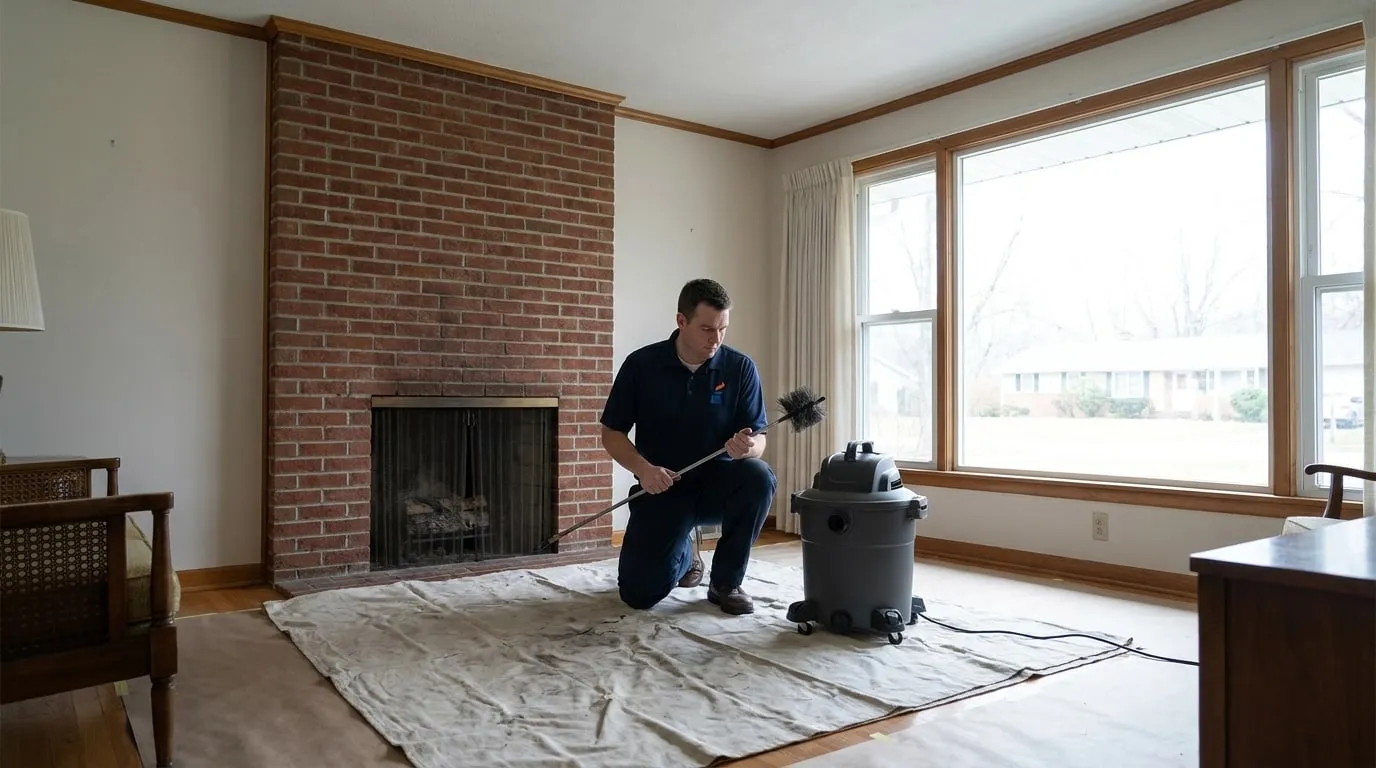
A crew member protecting the hearth of a 1950s Concord ranch home before opening the firebox, drop cloths already down across the living-room floor

What a sweep covers

Where the brush actually goes

The flue and the smoke chamber it feeds — traced against the same cutaway every service on this site uses.

The short answer

A sweep clears the season’s creosote from the flue with a brush matched to the liner’s exact diameter, run top to bottom until the buildup is gone rather than just knocked loose. We fold a Level 1 inspection into every visit — the walk-through of everything reachable without a camera, done on the same trip rather than billed as a second appointment. That matters more in Concord than in a market that burns steadily all winter: a fireplace here typically sits dead through a hot, rainless summer and gets lit cold on the season’s first chilly evening, so whatever crept up over the off months is still there waiting, unannounced, on day one. Dust sheets go down first, the brush work happens under sealed vacuum the entire time, and the firebox gets cleared out before we pack up.

One masonry stack, sliced open top to bottom: cap and mesh, then the crown, the flue liner threading down through the brick, the mortar between the courses, the roofline flashing, the smoke chamber, and finally the firebox at hearth level.01020304050607
  1. 01Cap and spark arrestor Screens embers, leaf litter and roosting birds from getting into the flue — sized to the mesh opening Concord’s own fire code calls for on a Diablo-wind day.
  2. 02Crown The angled cap poured across the top of the stack. Months of summer heat bake it until it cracks, and that first hairline is where the rainy season gets in.
  3. 03Flue liner Where the exhaust actually travels on its way out. Any breach here is a safety issue to fix right away, never a line item to defer.
  4. 04Mortar joints Hidden inside the wall once the crown starts leaking, this is the layer that quietly erodes while nobody’s watching.
  5. 05Flashing Where the stack punches through the roofline. Track a ceiling stain back far enough and it usually ends here.
  6. 06Smoke chamber The angled space a straight brush cannot reach. A lingering, musty odor after the season’s first fire almost always starts on this ledge.
  7. 07Firebox The single part of the whole setup a homeowner actually glances at without thinking — meaning damage anywhere else tends to surface here dead last.

Book this if you noticed

The usual signs

  • A campfire or burnt smell that hangs around the room once the fire’s out, worst on the first cold night after a long dry run.
  • Small black flakes turning up in the firebox with nobody having lit anything.
  • It has been over a year, or you genuinely cannot remember, since the last cleaning.
  • Smoke drifting into the living room instead of climbing the flue, especially with wind outside.

Not sure it is a sweep you need? Call (925) 854-4306 and describe it — we will point you to the right service.

What is included

The sweep, scoped plainly

Included

  • A top-to-bottom brush pass through the flue liner
  • Sealed-vacuum pickup of everything the brush knocks loose
  • An NFPA 211 Level 1 inspection of every reachable component
  • Full floor and hearth protection for the length of the visit
  • A written record of anything found, handed over before we go

Not included

  • Camera work on sections we can’t see directly — that’s a Level 2 inspection, priced on its own
  • Any masonry, crown or cap repair the sweep uncovers, scoped and quoted as its own job

A camera inspection and any repair work are separate services, quoted on their own so a sweep never turns into a surprise bill.

The visit

How a sweep actually goes

  1. 1

    Cover the work area

    Drop cloths come out before any tool does, running from the firebox opening out along the path we’ll actually be walking.

  2. 2

    Work the flue

    A brush cut to your liner’s diameter travels the full run, top to bottom, knocking the season’s creosote and soot loose.

  3. 3

    Vacuum under seal

    A HEPA unit stays clamped over the firebox opening for the whole pass, catching everything before it ever hits the room air.

  4. 4

    Walk the Level 1 checklist

    Flue, firebox and appliance connection all get a visual pass, looking for cracking, gapping or heat stress.

  5. 5

    Hand you notes, not a pitch

    Whatever turns up — however minor — gets written down before we head out, with zero pressure to sign off on anything right then.

A crew member protecting the hearth of a 1950s Concord ranch home before opening the firebox, drop cloths already down across the living-room floor

Sweep specifications

Sweep, by the numbers

What a sweep visit is actually held to — pulled from the standard the trade itself is measured against, not a figure we made up.

Inspection standard
NFPA 211, Level 1
Recommended frequency
Annually, with regular use
What gets brushed
Full length of the flue liner
Debris handling
Sealed vacuum extraction, floor protected
Typical visit length
45–75 minutes

NFPA 211: Standard for Chimneys, Fireplaces, Vents, and Solid Fuel-Burning Appliances.

In detail

What a sweep clears, and why it matters here

The mechanics of creosote buildup after a hot, dry Concord summer, and why an annual pass is the single most effective thing an owner can do.

01Where the creosote actually comes from

Every fire that burns leaves creosote behind — a tar-like film that forms as rising smoke cools against the inside of the flue.

Continue reading

Some amount is unavoidable and harmless. Left to build across a whole season of use, though, it stops being residue and starts being fuel sitting inside a passage that gets hot enough, occasionally, to set it off. Sweeping tackles that mechanically: a brush cut to match the liner’s diameter runs the whole run from firebox to cap, dislodging the buildup so the vacuum can carry it away rather than it stacking on top of last season’s layer.

Concord adds its own wrinkle to the timing. A fireplace here typically goes dark for a stretch of hot, bone-dry summer months, then gets lit again with little warning once the first cool evening arrives. That dormant period is not maintenance — the creosote left from the prior season is exactly as combustible as it was in April, and the first fire on an unswept flue is reliably when we field the most calls about a smell that will not go away.

02Keeping the mess where it belongs — outside the room

The soot, more than the work itself, is usually the real hesitation. Loosening a season’s creosote inside a tight flue produces debris that, left unmanaged, drops straight onto the hearth and spreads from there.

Continue reading

So we intercept it before it starts: drop cloths go over the hearth and the walkway well before any brush touches the flue, and a HEPA unit stays clamped to the firebox the whole time the brush is running, pulling everything into the machine the instant it comes loose. When we’re done, the room shouldn’t look any different than it did when we arrived.

03What the bundled inspection actually checks

Sweeping proves the flue is clear. It does not, on its own, prove the flue is safe — that’s the job of the Level 1 inspection that rides along with every visit.

Continue reading

Under NFPA 211, a Level 1 covers everything a technician can see and physically reach without a camera or roof ladder: the accessible run of the flue interior, the firebox, the smoke chamber sitting just above it, and the connection point where the appliance meets the chimney. It is the appropriate depth for a chimney in normal, continuous use with no recent equipment changes and nothing pointing toward hidden trouble.

Where that visual pass turns up something ambiguous — a crack that could run deeper than what’s visible, or damage that shows up after an unusually harsh summer or a hard freeze — we say so directly and recommend a camera-based Level 2 look rather than guessing past what a flashlight can actually confirm.

04Why Concord’s heat changes the calculus

Elsewhere, chimney wear is mostly a rain-and-moss story. Here it starts with sun: stretches of 90-plus-degree days bake a masonry crown until it develops hairline cracks purely from thermal cycling, months before the rainy season ever shows up to widen them.

Continue reading

That’s why a crown check rides along with every sweep here rather than getting billed separately — catching a crack in August, dry, is a much smaller job than catching the same crack in January, wet.

05What stretches the visit, and what never does

One flue, easy access, a single technician on site — figure an hour, floor covered the whole way through.

Continue reading

Things stretch beyond that with a second flue, a wood stove running its own connector pipe, or an attic hatch that’s a hassle to reach, and we’ll let you know up front if your job looks like it’ll run past the baseline. What stays fixed is the sequence itself, start to finish, whatever the property throws at us or however long it’s genuinely been since anyone last looked.

06Serving Concord and the rest of Contra Costa County

We cover a twenty-mile radius out from central Concord. Let us know when the flue was last serviced, if you happen to know, and mention anything you’ve noticed — smell, smoke, debris — so we can plan around it before we’re already on the ladder.

Reviews

What the last 10 customers actually said

5.0

10 Google reviewscounted 2026-08-26

  • 510
  • 40
  • 30
  • 20
  • 10
  • Barbara Rhodes

    After a worker cleaned the smoke chamber and swept away baked-on soot from the upper flue walls, the smell of creosote that had been there since the warm summer months was gone.
  • Norma Peterson

    Discolouration on the brick facing led to a deep inspection and sweep, removing concealed creosote pockets behind the lintel, eliminating smoke spilling across the room.
  • Evan Hughes

    Very concerning chimney downdraft caused by strong winds was rectified when the sweep eliminated a substantial soot ring at the crown that had been obstructing the natural exit flow.
  • Kannon Odom

    Our winter parties were about to be ruined by the extreme draft resistance, but a planned sweep found a collapsed inside baffle, cleared the route, and optimized the heat distribution.
  • Daniel Rodriguez

    We cleaned out our wood burning fireplace insert just before winter set in. The airway is wide open, the heat output this season is considerably better.

Read all 10 reviews on Google

Questions

What people ask about a sweep

How often does a Concord fireplace actually need sweeping?

Once a year covers regular winter use, per NFPA 211 — a wood stove run daily wants it more often, while a fireplace lit only a few times a season can sometimes stretch that.

Is this going to leave soot all over my living room?

It really shouldn’t — the floor gets covered before we begin, and the vacuum stays clamped over the firebox opening for the whole brush pass, so there’s nowhere for the mess to end up except inside the machine.

Do gas fireplaces get swept the same way?

Different service entirely — a gas unit doesn’t build up creosote the way wood does, so what it actually needs is a check of the venting and burner components. Just let us know which type you’re dealing with.

What if the technician finds a problem mid-visit?

It gets written down and explained in plain terms on the spot. Nothing gets repaired that same day without your go-ahead, and there’s never pressure to commit to anything immediately.

Isn’t a sweep basically the same as an inspection?

A sweep carries a Level 1 inspection with it — everything visible without a camera. A full Level 2 camera inspection is its own, deeper service; see the chimney inspection page for that.

Get on the schedule

Rough idea of when it was last done helps, but isn’t required — we’ll figure out the right visit either way.

Or call (925) 854-4306 to book directly.

Tell us what changed.

Tell us what the fireplace is doing and what changed. Someone reads every message that comes in.

No commitment either way — we call back and settle on a time that works.

Prefer to talk? Call (925) 854-4306 — we’ll confirm when we can help.