Chimney caps · Concord

Chimney caps and spark arrestors in Concord

It’s the cheapest part of the whole system — which is easy to assume means it doesn’t matter much. Here, it does.

No commitment either way — we call back and settle on a time that works.

  • Somewhere between thirty and sixty minutes for a straightforward single-flue swap or new fit.
  • A properly sized stainless cap with code-legal mesh, fitted and sealed.
  • Roof access plus a measurement of the flue’s outer diameter, taken before we order anything.
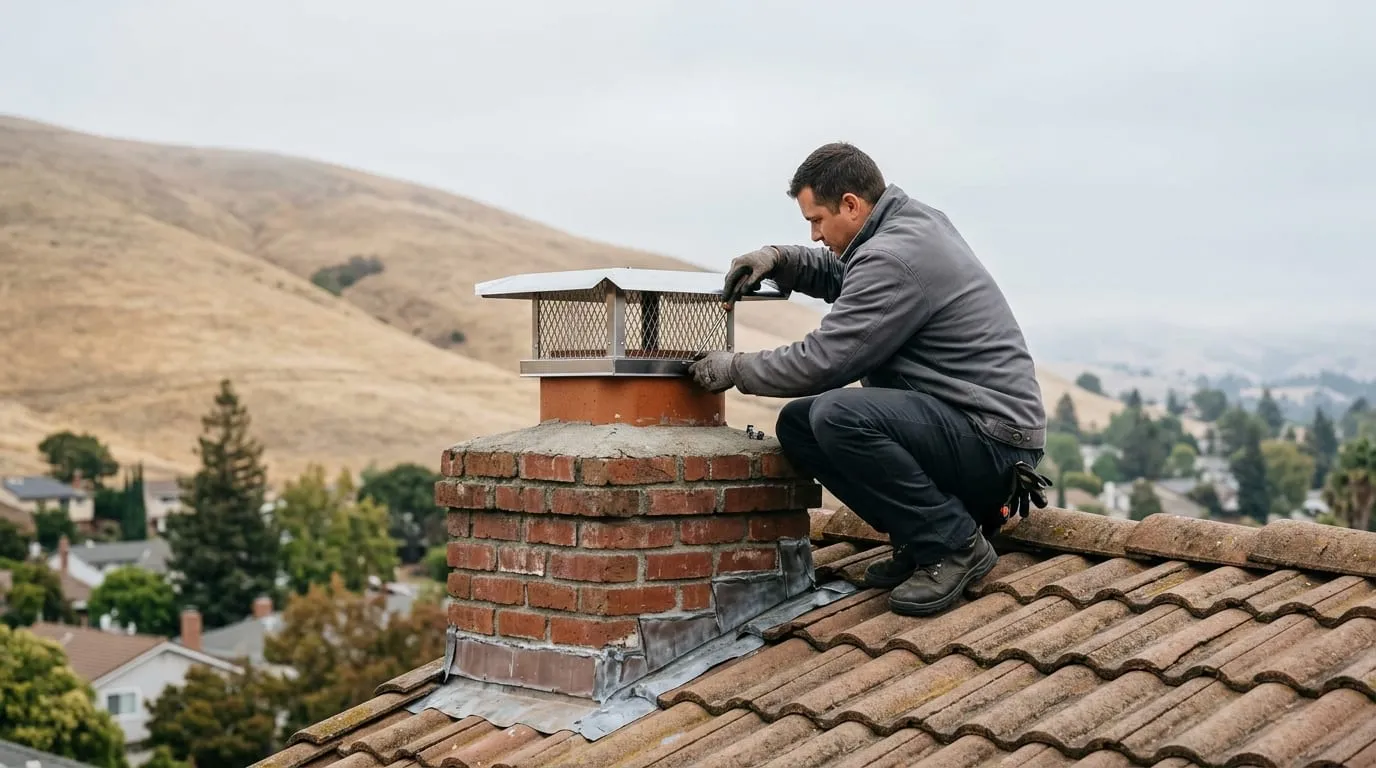
A technician fitting a new stainless steel chimney cap with spark-arrestor mesh on a tile-roofed Concord home, dry hillside visible in the background

What a cap covers

The smallest part with the most exposure

Cap and spark arrestor, right at the top of the stack — traced against the same cutaway every service on this site uses.

The short answer

Up at the top of the flue sits the cap: a metal cover with spark-arrestor mesh built into its sides, keeping embers contained on the way out while keeping rain, wildlife and falling debris on the way in. It costs the least of anything on the chimney and yet takes the most direct hit from two things Concord throws at it constantly — a fall Diablo-wind event pushing embers toward any open gap, and the steady shed of debris off Mount Diablo’s dry hillsides and the mature trees lining older Diablo Valley streets. We fit stainless caps matched to your flue’s actual size, with mesh cut to California fire-code openings, so it holds up the one time it really gets tested instead of failing right when it matters.

One masonry stack, sliced open top to bottom: cap and mesh, then the crown, the flue liner threading down through the brick, the mortar between the courses, the roofline flashing, the smoke chamber, and finally the firebox at hearth level.01020304050607
  1. 01Cap and spark arrestor Screens embers, leaf litter and roosting birds from getting into the flue — sized to the mesh opening Concord’s own fire code calls for on a Diablo-wind day.
  2. 02Crown The angled cap poured across the top of the stack. Months of summer heat bake it until it cracks, and that first hairline is where the rainy season gets in.
  3. 03Flue liner Where the exhaust actually travels on its way out. Any breach here is a safety issue to fix right away, never a line item to defer.
  4. 04Mortar joints Hidden inside the wall once the crown starts leaking, this is the layer that quietly erodes while nobody’s watching.
  5. 05Flashing Where the stack punches through the roofline. Track a ceiling stain back far enough and it usually ends here.
  6. 06Smoke chamber The angled space a straight brush cannot reach. A lingering, musty odor after the season’s first fire almost always starts on this ledge.
  7. 07Firebox The single part of the whole setup a homeowner actually glances at without thinking — meaning damage anywhere else tends to surface here dead last.

Book this if you noticed

The usual signs

  • No cap present at all — an open flue with nothing between it and rain, debris or wildlife.
  • Visible rust, dents or holes in an existing mesh screen.
  • Signs of birds, squirrels or nesting material inside the flue or firebox.
  • A home backing onto open space or hillside brush toward Clayton or the Mount Diablo foothills, where ember exposure during a wind event is a genuine concern.

Not sure if you need a new cap or just a mesh check? Call (925) 854-4306 and describe it — we will confirm.

What is included

The cap install, scoped plainly

Included

  • A stainless cap matched exactly to your flue’s outer diameter
  • Spark-arrestor mesh cut to California fire-code sizing
  • A secure, weather-tight fit at the flue or crown
  • A visual crown check while the technician’s already up there

Not included

  • Crown repair or rebuild, priced separately if the crown itself needs it
  • Multi-flue chases or custom-fabricated caps, scoped and quoted independently

Crown repair and custom fabricated caps are quoted separately, so a cap swap never turns into a surprise bill.

The visit

How a cap installation actually goes

  1. 1

    Measure first

    We get an exact reading on the flue’s outer diameter or opening before ordering, so the fit is right the first try.

  2. 2

    Look at the crown while we’re up there

    With a technician already at the top of the stack, the crown gets a visual once-over at no extra trip.

  3. 3

    Set the cap

    A stainless cap with compliant mesh gets secured to the flue or crown, sized to sit flush without choking the draft.

  4. 4

    Test the seal

    We check that the fit is secure and weather-tight enough to hold through a wind event, not just look right from the ground.

  5. 5

    Note anything else

    Whatever else turns up at the top — crown wear, flashing, mortar — gets written down before we head down.

A technician fitting a new stainless steel chimney cap with spark-arrestor mesh on a tile-roofed Concord home, dry hillside visible in the background

Cap specifications, by code

What the code actually requires

The figures a cap gets held to in this state — set by the fire code itself, not something we eyeballed.

Mesh opening size
3/8 in. to 1/2 in.
Material
19-gauge galvanized or 24-gauge stainless steel
Net free area
At least 4× the flue’s net free area
Accessibility
Removable for flue cleaning, per code
WUI-adjacent properties
Ember-resistant mesh checked against defensible-space rules

California Fire Code (based on the International Fire Code), spark-arrestor provisions.

In detail

What Diablo winds specifically test

Why the mesh matters more here than in a milder climate, and what a wildland-adjacent property needs to check that a central-Concord property does not.

01Small part, outsized exposure

A cap is a simple object on paper — sheet metal, a mesh screen, a handful of fasteners — easy to treat as an afterthought next to a crown rebuild or liner swap.

Continue reading

That would be the wrong call here specifically. It occupies the single most exposed spot on the entire structure, sitting directly in the path of whatever a fall Diablo-wind event is carrying, and its whole purpose is keeping something dangerous OUT rather than containing anything the fireplace produces. Where a hairline crack in a crown fails slowly and quietly, corroded mesh or a missing cap fails at exactly the wrong moment — the instant a wind-driven ember reaches it.

02What a Diablo wind event actually tests

Diablo winds are the hot, dry offshore gusts that define Contra Costa’s fall fire-weather stretch, named for the peak at the center of the region.

Continue reading

They put a cap through two distinct stresses: carrying embers from a nearby wildfire — or even routine yard burning — much farther than they’d travel on a calm day, and physically working at a loosely seated cap over repeated events until screws and clips give way in a way a gentler climate never produces. A cap that’s sat through several fire seasons unchecked can look fine from the ground while its mesh is quietly gapped or thinned enough to let debris, or worse, straight through.

03Mesh size isn’t a preference, it’s a spec

California’s fire code, drawn from the International Fire Code, sets a defined range for spark-arrestor mesh: openings between 3/8 and 1/2 inch, built from 19-gauge galvanized steel or 24-gauge stainless.

Continue reading

That range exists for a reason — finer mesh restricts airflow and clogs fast with creosote and debris, while coarser mesh stops doing its actual job of stopping sparks. Every cap we fit lands inside that range, and on a property nearer the wildland-urban interface around Mount Diablo — closer to Clayton or the foothills than to central Concord — we treat mesh condition as something worth confirming on every single visit, not just at the original install.

04Embers aren’t the only thing landing on your roof

The dry oak-and-grass hillsides around Mount Diablo, along with the mature street trees common in Diablo Valley’s older neighborhoods, shed onto rooftops steadily through the dry season — leaves, twigs, and heavier debris once the wind picks up.

Continue reading

An open flue or a cap with compromised mesh collects all of it directly, and dry organic material sitting at the top of a flue is its own small fire hazard, separate from anything happening outside the property line. A properly fitted cap simply keeps that material on the roof where it belongs.

05What changes the length of the visit

A single-flue swap on a roof you can walk is the standard job — under an hour, one technician, a measurement taken before we even place the order so it fits on the first attempt.

Continue reading

A multi-flue chase, a steep or awkward roof, or a custom-fabricated cap for an unusual flue shape adds time, and we’ll say so before ordering anything. The order of operations stays the same regardless: measure, check the crown while already up there, fit and seal the cap, verify it, note whatever else was seen.

06Booking a cap across Concord and Contra Costa County

If there’s no cap at all, or the one you’ve got shows rust, gaps or visible damage, that’s worth handling ahead of the next Diablo-wind event rather than after one hits.

Continue reading

Mention whether the property backs onto open space or hillside brush when you call — it changes what we’re checking for, not what actually goes on the flue.

Reviews

What the last 10 customers actually said

5.0

10 Google reviewscounted 2026-08-26

  • 510
  • 40
  • 30
  • 20
  • 10
  • Barbara Rhodes

    After a worker cleaned the smoke chamber and swept away baked-on soot from the upper flue walls, the smell of creosote that had been there since the warm summer months was gone.
  • Norma Peterson

    Discolouration on the brick facing led to a deep inspection and sweep, removing concealed creosote pockets behind the lintel, eliminating smoke spilling across the room.
  • Evan Hughes

    Very concerning chimney downdraft caused by strong winds was rectified when the sweep eliminated a substantial soot ring at the crown that had been obstructing the natural exit flow.
  • Kannon Odom

    Our winter parties were about to be ruined by the extreme draft resistance, but a planned sweep found a collapsed inside baffle, cleared the route, and optimized the heat distribution.
  • Daniel Rodriguez

    We cleaned out our wood burning fireplace insert just before winter set in. The airway is wide open, the heat output this season is considerably better.

Read all 10 reviews on Google

Questions

What people ask about caps

It’s gone this long without a cap — does it really need one now?

If there isn’t one already, yes. An open flue is a direct route for rain, wind-driven embers and animals hunting for a nesting spot — a cap is the least expensive fix on the entire chimney and often the one that heads off a much bigger repair.

What mesh size does California’s code actually call for?

Openings sized between 3/8 and 1/2 inch, made from either 19-gauge galvanized or 24-gauge stainless material, with net free area running at least four times the flue’s own — every cap we install is sized to that standard, not a generic off-the-rack fit.

Will adding a cap choke the draft or make the fireplace smoky?

A correctly sized one shouldn’t. When a cap does hurt draft, it’s almost always because it’s undersized or pinched at the base — which is exactly why we take a real measurement before ordering instead of guessing.

How long does a cap typically last before it needs swapping?

A good stainless one can run well past a decade. The mesh tends to go first — corrosion or wind/debris damage — which is why we check it on every sweep and inspection visit, not only when someone calls specifically about the cap.

Does being near Clayton or the Mount Diablo foothills change what I need?

It changes how closely we check the mesh, not what gets installed. Closer to wildland vegetation, we pay particular attention to ember-resistant mesh condition, since a gapped or corroded screen there is a genuine fire-season exposure point.

Book a cap installation

Tell us if the property backs onto open space — it changes what we check, not what we install.

Or call (925) 854-4306 to book directly.

Tell us what changed.

Tell us what the fireplace is doing and what changed. Someone reads every message that comes in.

No commitment either way — we call back and settle on a time that works.

Prefer to talk? Call (925) 854-4306 — we’ll confirm when we can help.