Chimney inspection · Concord

Chimney inspection in Concord

Unsure whether this calls for a basic look or the full camera treatment? That gets sorted before anyone’s on the roof.

No commitment either way — we call back and settle on a time that works.

  • Roughly thirty minutes for a Level 1 walkthrough; closer to an hour once a camera’s involved at Level 2.
  • A written report naming exactly which level was performed and everything it turned up.
  • For Level 2 work, open access to the attic or crawlspace, wherever either one exists.
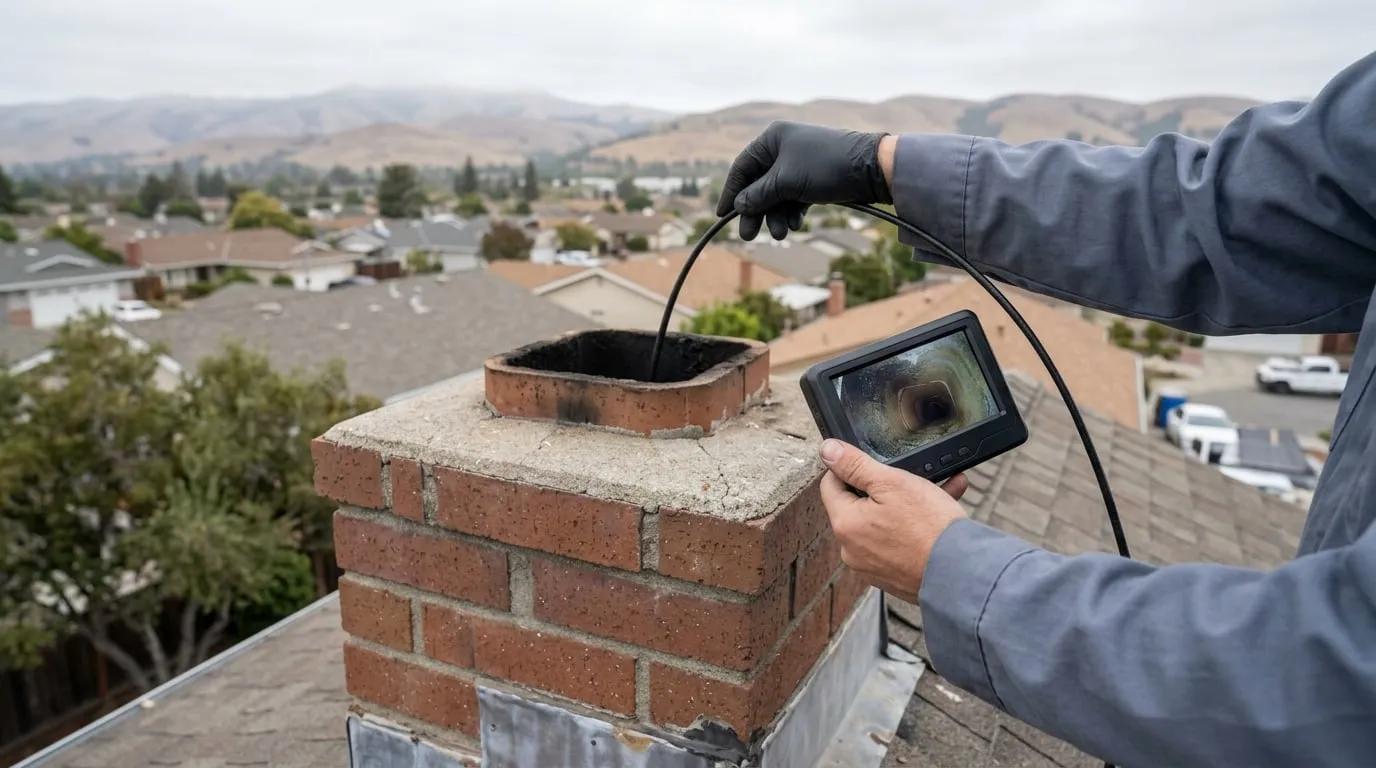
A flexible-rod inspection camera lowered into a flue while a technician watches the live feed on a handheld monitor

What an inspection covers

How deep each level actually looks

From a visual check to a full camera run — traced against the same cutaway every service on this site uses.

The short answer

NFPA 211 splits a condition review into three depths, and matching the right one to your actual situation is most of the job. Level 1 is a visual pass through everything reachable by eye, appropriate for a chimney in ordinary, unchanged use. Level 2 brings a video camera down the flue plus a check of the attic, crawlspace and roof areas it touches — this is what a Contra Costa sale typically asks for, and what makes sense after swapping in a new appliance. Level 3 goes furthest, called for only when something structural is genuinely in question, and can mean opening a concealed section to see what’s actually there. We tell you which one your situation calls for up front, rather than steering toward whichever costs the most.

One masonry stack, sliced open top to bottom: cap and mesh, then the crown, the flue liner threading down through the brick, the mortar between the courses, the roofline flashing, the smoke chamber, and finally the firebox at hearth level.01020304050607
  1. 01Cap and spark arrestor Screens embers, leaf litter and roosting birds from getting into the flue — sized to the mesh opening Concord’s own fire code calls for on a Diablo-wind day.
  2. 02Crown The angled cap poured across the top of the stack. Months of summer heat bake it until it cracks, and that first hairline is where the rainy season gets in.
  3. 03Flue liner Where the exhaust actually travels on its way out. Any breach here is a safety issue to fix right away, never a line item to defer.
  4. 04Mortar joints Hidden inside the wall once the crown starts leaking, this is the layer that quietly erodes while nobody’s watching.
  5. 05Flashing Where the stack punches through the roofline. Track a ceiling stain back far enough and it usually ends here.
  6. 06Smoke chamber The angled space a straight brush cannot reach. A lingering, musty odor after the season’s first fire almost always starts on this ledge.
  7. 07Firebox The single part of the whole setup a homeowner actually glances at without thinking — meaning damage anywhere else tends to surface here dead last.

Book this if you noticed

The usual reasons to book one

  • There’s a pending sale and the buyer’s side has requested a chimney inspection.
  • You’ve just taken ownership and have zero record of prior servicing.
  • A fire-season ember event or a hard freeze happened, and you want it checked before lighting anything.
  • You’re swapping appliances — wood insert to gas, say — and need the flue confirmed for the new fuel type.

Not sure which level you need? Call (925) 854-4306 and describe the situation — we will confirm the right one.

What is included

The inspection, scoped plainly

Included

  • Whichever NFPA 211 level actually fits your stated reason for calling
  • A written report you keep on file, not a verbal rundown
  • Camera footage of the flue interior on Level 2 and Level 3 work
  • A plain-language explanation of every finding before we leave

Not included

  • Repair work the inspection turns up — priced separately so the inspection stays an honest, independent read
  • Opening finished walls or ceilings for a Level 3 without your sign-off first

Any repair work an inspection turns up is quoted separately, so a check never turns into a surprise bill.

The visit

How an inspection actually goes

  1. 1

    Pin down the right level

    We settle on the depth that actually fits before touching anything — sale, appliance swap, storm exposure and routine use all point to something different.

  2. 2

    Visual plus camera work

    For Level 2, a camera travels the full flue length while the exterior, crown and every joint gets a visual pass at the same time.

  3. 3

    Attic and crawlspace pass

    Anywhere the chimney runs through an attic or crawlspace, we verify clearances to combustibles and flag gaps or heat damage.

  4. 4

    Everything goes in writing

    Structural findings, cosmetic ones, all of it lands in a written report you keep — with camera stills attached where they’re relevant.

  5. 5

    A plain-language walkthrough

    Before we head out, we go over what the report actually means and what, if anything, is worth doing next and on what timeline.

A flexible-rod inspection camera lowered into a flue while a technician watches the live feed on a handheld monitor

Inspection levels

Inspection levels, defined

Three depths of review, each triggered by something different — set by the same national standard the whole trade answers to.

Level 1
Visual check, no camera — annual use, unchanged system
Level 2
Video camera, plus attic/crawlspace — sale, appliance change
Level 3
Concealed-area access — after damage or a suspected structural issue
Camera used
Level 2 and Level 3 only
Typical Level 2 length
60–90 minutes

NFPA 211: Standard for Chimneys, Fireplaces, Vents, and Solid Fuel-Burning Appliances, Level 1–3 definitions.

In detail

Three levels, three different questions

Why matching the level to the actual question is most of what makes an inspection useful, and what Concord’s climate adds to the checklist.

01One name, three different questions

NFPA 211 doesn’t treat “inspection” as a single fixed procedure — it splits it into three levels, each built around a different question.

Continue reading

Level 1 asks the simple one: under its current, unchanged use, is this chimney in reasonable shape? Level 2 asks something bigger: is it sound enough to carry through a change — new ownership, a different appliance, altered venting? Level 3 asks the biggest question of all: is there real reason to suspect something structural, and if so, what exactly? Getting the level right is most of what separates a useful inspection from one that’s either too shallow to catch a real issue or too invasive for a routine look.

02Level 1 — the yearly check

Level 1 is what rides along with a standard sweep: a visual pass through everything reachable without a camera or roof ladder — the accessible flue run, the firebox, the smoke chamber, and the appliance connection.

Continue reading

It’s built to answer one ordinary question every year: has anything changed in a system that’s being used the same way it always has. For most fireplaces, most years, nothing deeper is needed.

03Level 2 — for a sale, a new appliance, or an unknown past

Level 2 adds a video camera traveling the full flue length, plus a look at whatever attic, crawlspace or roof area the chimney passes through.

Continue reading

It’s what most Contra Costa real-estate deals end up requiring at a change of ownership, since it hands a buyer or seller actual camera evidence of the flue’s interior rather than a surface impression. It’s also the right move whenever a chimney’s history is a blank — a recently purchased house, an inherited property, a fireplace nobody in the home has ever had checked — and whenever you’re changing what the flue is venting, such as switching from wood to gas.

04Level 3 — when something structural is genuinely in question

Level 3 exists for a narrower set of circumstances: visible structural damage, a lightning strike, or suspected harm after an unusual event, where Level 1 or 2 alone can’t settle the real question.

Continue reading

It can mean opening a concealed section — behind drywall, under roofing — to see what a flashlight and camera can’t. This isn’t the default recommendation; it comes up only when the situation actually warrants it, and never without your go-ahead before anything gets opened.

05What Concord’s summers add to the list

Beyond the standard NFPA checks, an inspection here specifically watches for heat-cycling damage on the crown — the fine cracking that comes from months at temperatures well past 90°F rather than from freeze-thaw cycles.

Continue reading

For a property closer to open space near Clayton or the Mount Diablo foothills, we also give the spark-arrestor mesh a closer look, since corrosion or gapping there carries real fire-season risk in a way it simply doesn’t further from wildland vegetation.

06Booking an inspection in Concord and across Contra Costa County

Tell us why you’re calling — a closing on the calendar, a new appliance, storm or fire-season exposure, or just an unknown history — and we’ll settle on the right level before scheduling anything, rather than defaulting to the deepest option available.

Reviews

What the last 10 customers actually said

5.0

10 Google reviewscounted 2026-08-26

  • 510
  • 40
  • 30
  • 20
  • 10
  • Barbara Rhodes

    After a worker cleaned the smoke chamber and swept away baked-on soot from the upper flue walls, the smell of creosote that had been there since the warm summer months was gone.
  • Norma Peterson

    Discolouration on the brick facing led to a deep inspection and sweep, removing concealed creosote pockets behind the lintel, eliminating smoke spilling across the room.
  • Evan Hughes

    Very concerning chimney downdraft caused by strong winds was rectified when the sweep eliminated a substantial soot ring at the crown that had been obstructing the natural exit flow.
  • Kannon Odom

    Our winter parties were about to be ruined by the extreme draft resistance, but a planned sweep found a collapsed inside baffle, cleared the route, and optimized the heat distribution.
  • Daniel Rodriguez

    We cleaned out our wood burning fireplace insert just before winter set in. The airway is wide open, the heat output this season is considerably better.

Read all 10 reviews on Google

Questions

What people ask about inspections

Is an inspection legally required to sell a house here?

There’s no countywide requirement, but a Level 2 — the depth NFPA 211 points to at a change of ownership — is what most Contra Costa transactions end up asking for, and we can turn one around fast for a closing deadline.

How’s this different from the inspection bundled with a sweep?

A sweep includes a Level 1 — visual only, nothing a camera couldn’t skip. A standalone inspection can go to Level 2 or 3, running a camera down the flue and, when warranted, opening up concealed areas.

New homeowner, zero service history — where do I start?

Level 2 is the sensible starting point when nothing’s known about a chimney’s past — camera footage of the interior plus a written baseline before you light your first fire.

Does Concord’s summer heat change what gets checked?

It does — we specifically look for heat-cycling cracks on an exposed crown here, on top of the usual mortar, flashing and liner review any inspection covers.

Book an inspection

Tell us the reason — a pending sale, an unknown history, or an annual check — and we will confirm the right level.

Or call (925) 854-4306 to book directly.

Tell us what changed.

Tell us what the fireplace is doing and what changed. Someone reads every message that comes in.

No commitment either way — we call back and settle on a time that works.

Prefer to talk? Call (925) 854-4306 — we’ll confirm when we can help.