Diablo winds, ember risk, and what a chimney cap actually has to survive
Diablo winds are Contra Costa County’s defining fall fire-weather event — hot, dry, offshore gusts that test a chimney cap’s mesh in a way still air never does. Here is what actually fails, and why the fix is usually the cheapest part on the chimney.
Published
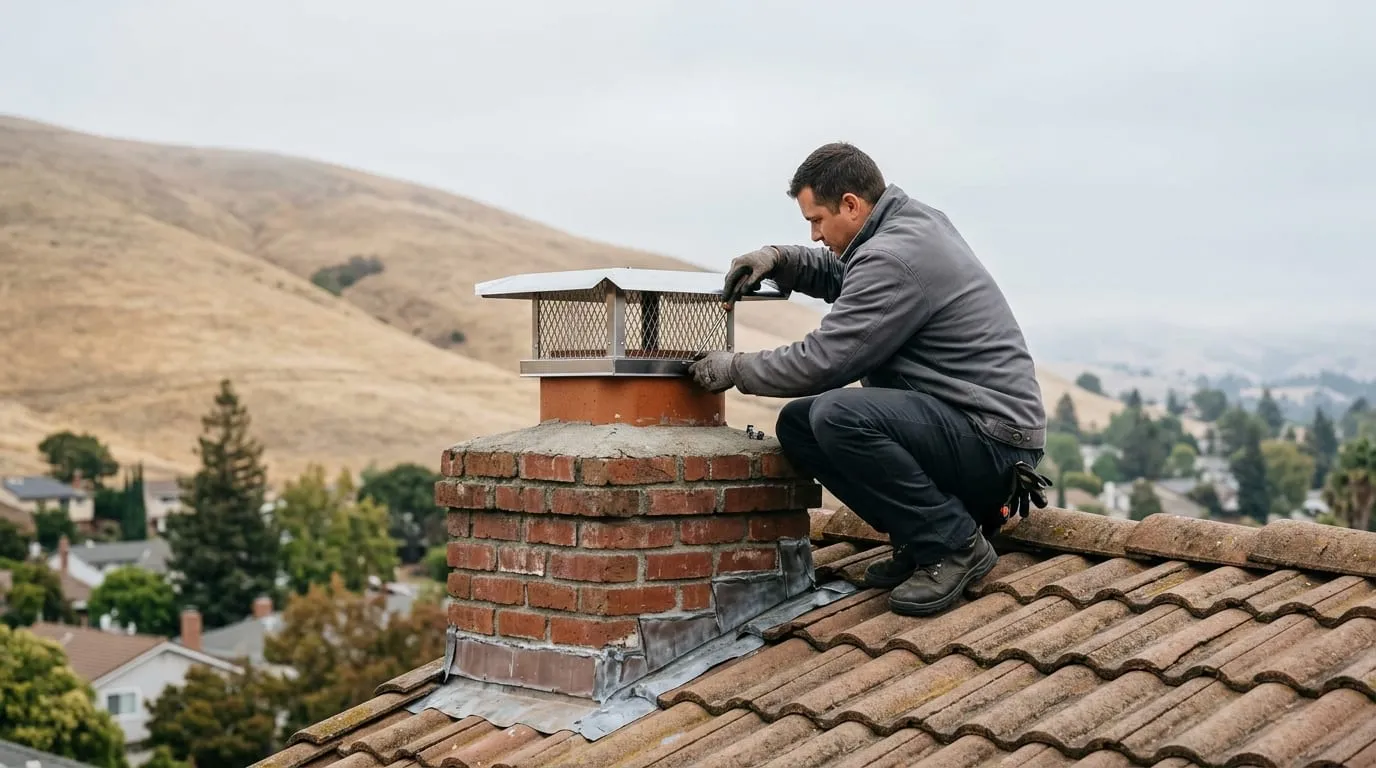
Every fall, Contra Costa County gets a specific kind of weather event: hot, dry, offshore wind gusts blowing out from the interior toward the coast, named for the mountain that sits at the center of the territory they cross. Diablo winds do not just raise fire danger in the hills — they put a very specific, very direct kind of stress on one small component most homeowners never think about: the mesh screen on a chimney cap.
What a Diablo wind event actually does to a cap
On a still day, a chimney cap’s mesh mostly has to keep out rain, leaves and the occasional bird. During a Diablo wind event, the job changes completely. Sustained gusts can carry embers from a nearby fire — wildland or otherwise — much further and much faster than calm air would, and a chimney’s flue opening is exactly the kind of gap those embers are looking for. A cap with intact, correctly sized mesh stops that ember cold. A cap with a gapped, corroded or missing screen does not, and the difference between the two is rarely visible from the ground.
Wind also does something more mundane but just as important: it works loose whatever is not fully secured. A cap that was fitted correctly but has gone several fire seasons without a check can have fasteners that have loosened, a seam that has started to lift, or a screen that has thinned from repeated flexing in strong gusts. None of that shows up as an obvious problem until the one day it matters most.
Mesh sizing is set by code, not habit
California’s fire code, built on the International Fire Code, specifies exactly how fine or coarse spark-arrestor mesh is allowed to be: openings between 3/8 inch and 1/2 inch, in 19-gauge galvanized steel or 24-gauge stainless. That range is not arbitrary. Mesh finer than the minimum restricts airflow and clogs with creosote far too quickly; mesh coarser than the maximum stops actually arresting sparks, which defeats the entire point of the component. We check every cap against that range, not against whatever came standard on it years ago.
Why properties near Clayton and the Mount Diablo foothills carry more of this risk
Ember risk is not evenly distributed across the service area. A home in central Concord surrounded by other structures and managed landscaping has a meaningfully different exposure than a property closer to open space toward Clayton or the lower slopes of Mount Diablo itself, where dry grassland and oak woodland sit much closer to the building envelope. On those properties, we treat spark-arrestor mesh condition as something to specifically verify on every visit — sweep, inspection or repair — rather than only when a cap installation is the reason for the call.
The part that gets missed: debris, not just embers
Diablo winds and the dry season around them do something else worth mentioning: they move a lot of debris. Dry leaves, small twigs and dust get stripped off trees and hillside vegetation and end up on roofs and in anything open to the sky, including an uncapped or poorly sealed flue. A build-up of dry organic debris sitting at the top of a chimney is a small fire risk on its own, independent of any external ember source — one more reason an open or poorly capped flue is worth closing up before fire season, not just during it.
What we actually check, and how fast it goes
A cap check is quick, which is part of why it gets skipped. On a sweep or inspection visit, a technician already has eyes on the top of the stack — checking mesh condition, fastener tightness and overall fit takes a few extra minutes, not a separate appointment. If a cap needs replacing outright, a straightforward single-flue swap on an accessible roof typically runs under an hour, start to finish, once the flue’s outside diameter has been measured and the correct stainless cap is on hand.
What this is not: a reason to panic about every windy day
None of this means every gust of wind is a fire emergency waiting to happen. Diablo wind events are a predictable, seasonal pattern, not a constant condition, and a chimney with a properly sized, well-fitted cap handles them the way it is designed to. The point is narrower and more practical: this is one of the few chimney components where the cost of getting ahead of a problem is genuinely small, and the cost of not checking is not.
Getting ahead of fire season
The practical window to check cap and mesh condition is before Diablo wind season gets underway in earnest, not during an active event or after one has already tested a weak spot. If it has been more than a couple of years since anyone looked at the cap specifically — separate from a routine sweep — that is worth a call, especially on a property with any real proximity to open space or hillside vegetation.
Read next
More from the blog
The BART-era building boom and what it means for a 1970s Contra Costa chimney
BART reached central Contra Costa County in 1973 and turned a string of towns into commuter suburbs almost overnight, with tract housing built quickly to match. A lot of that housing carries factory-built metal chimneys rather than original masonry, and they age in a completely different way.
What a Contra Costa home sale actually requires from a chimney inspection
Contra Costa County’s active housing market — from Diablo Valley starter homes to San Ramon Valley move-up buyers — puts a chimney inspection request in front of a lot of sellers and buyers every month. Here is what the request usually means, and what level of inspection actually answers it.
Delta humidity, ag dust and what they do to flashing in eastern Contra Costa
The Delta edge of Contra Costa County — Antioch, Pittsburg, Brentwood — runs a noticeably different air pattern from the Diablo Valley core: more humidity swing, more wind-carried dust off surrounding farmland. Here is how that combination specifically wears on a chimney’s flashing seams.
Get your cap checked before fire season
Describe your property’s exposure — we will tell you plainly whether the existing cap and mesh are enough.